Boyard A2L Outdoor Refrigeration Unit
Boyard A2L Outdoor Refrigeration Unit – The Next Generation of Low-GWP Refrigeration The global refrigeration industry…
The moving components of the rotary compressor include crankshaft, piston, vane, upper and lower bearing, and cylinder. Multiple frictional pairs are formed between components, refrigeration oil forms an oil film between them reducing direct contact and wear, thereby enhancing compressor’s work efficiency and reliability. Reasonable oil supply system should be designed for compressor’s pump structure to make sure sufficient oil supply between frictional pair. Due to the differences in the structural design of vertical and horizontal compressors, corresponding lubrication and oil supply system, as well as their installation and application adaptability, also differ.
In a typical rotary compressor, lubricating oil is supplied through a spiral oil guide installed at the center of the crankshaft. When crankshaft rotates, spiral oil guide rotates with it, generating an upward spiraling force which draws refrigeration oil from the bottom of the compressor into radial oil holes positioned at the interfaces between crankshaft and other rotating components. Oil is subsequently supplied to each frictional pair for lubrication.
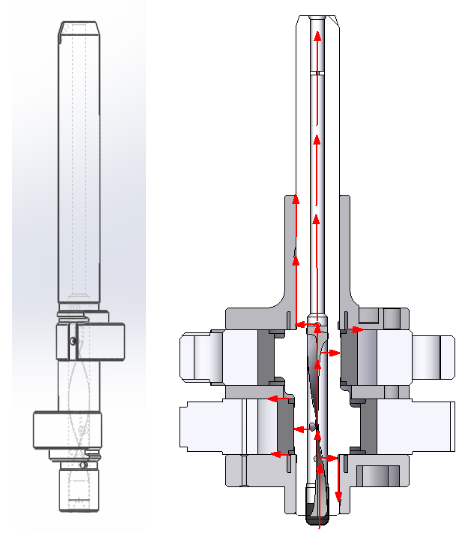
The oil supply system is driven by the upward spiral force produced by spiral oil guide, which means that the end of the oil guide needs to be in contact with the oil reservoir at the bottom to transport refrigeration oil at the bottom of the compressor to each moving frictional pair continuously. Based on its operating principle, vertical rotary compressor must be installed vertically, and the end of the oil guide must remain fully immersed in the oil reservoir under all installation angles and orientations to make sure reliable oil supply and lubrication.
When installing horizontal rotary compressor, crankshaft should be parallel to the mounting surface. At this point, distance between the base of lubricating oil reservoir and the center of the main shaft is relatively large. Therefore, vertical compressor’s oil supply and lubrication structure is unsuitable for horizontal compressor. Throughout the development of horizontal compressors, four types of oil-supply mechanisms have been developed: a. centrifugal oil supply, b. pump oil supply, c. differential-pressure oil supply and d. jet oil supply.
The four oil-supply configurations described above were primarily used in early-generation, low-powered product. With the gradual increase in the capacity of compressor’s volume and pressure from manufacturing processes and aims for lowering cost, baffle-type differential-pressure oil supply system becomes the commonly used configuration today:
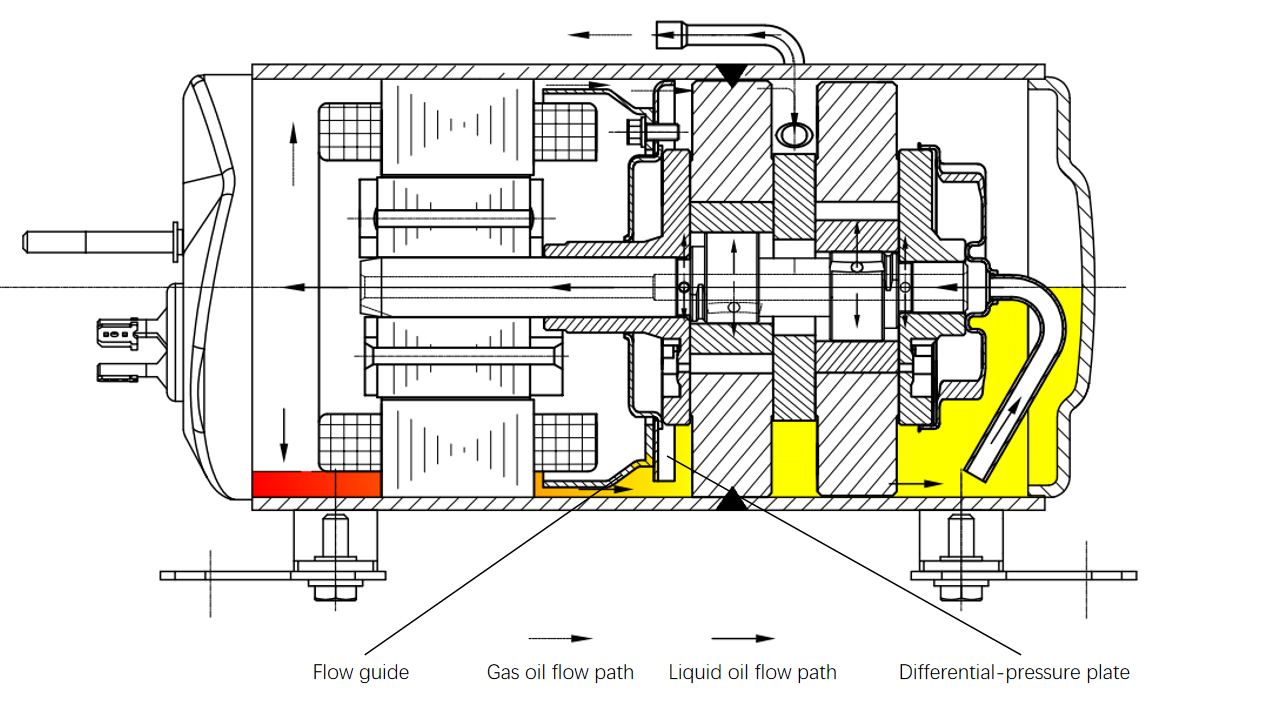
The figure shows oil and gas path inside a compressor. The interior of the compressor housing is a high-pressure chamber, differential-pressure plate separates the interior of the compressor into part A on the left, on the electric motor side and part B on the right, on the pump side.
All the compressed gas is initially discharged into chamber A. Then returns to the pump side (chamber B) by passing through the gap between the outer edge of the electric motor and the inner wall of housing and through the gap between outer flow guide and the inner wall of housing. The main procedure is: compressor suction port→suction chamber→compression chamber→discharge port→electric motor chamber(chamber A)→(gap between differential-pressure plate and housing) gas circuit gap→pump side chamber (chamber B)→housing discharge port
Due to the presence of differential-pressure plate, the structure inside of the compressor is divided into part A and B where PA>PB. Because there is a pressure differenceΔP between part A and B, some of the refrigeration oil at the electric motor side is pushed to the pump side. Therefore, when compressor is operating, oil surface remains high enough at the pump side satisfying the need of lubrication for the compressor operation. The main procedure is: pump side oil reservoir→suction oil pipe→ oil path of crankshaft → every frictional pair → electric motor side oil reservoir → returns to pump side oil reservoir.
Baffle-type differential-pressure oil supply system ensures horizontal compressor to have sufficient oil supply even under condition with compressor at a tilted angle and to keep normal oil supply and operation.