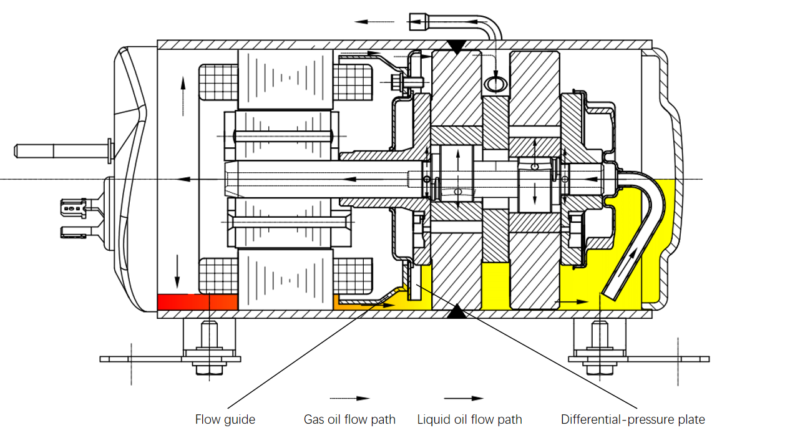
Understanding Oil Supply in Rotary Compressor
Operating Principle of the Oil Supply and Lubrication System in Rotary Compressor The moving components of…
The concept of applying rotary structures to refrigeration compressors dates back to 1857, when such designs were first explored for liquid pumps and refrigerator compressors. Thanks to their simple construction, fewer components, low vibration, smooth operation and high reliability, rotary compressors have gained strong momentum. With advances in technology and industrial chains, rotary compressors, featuring compact size, lightweight design, controllable cost and low failure rate, are gradually replacing reciprocating and scroll compressors in the frozen and refrigeration market.
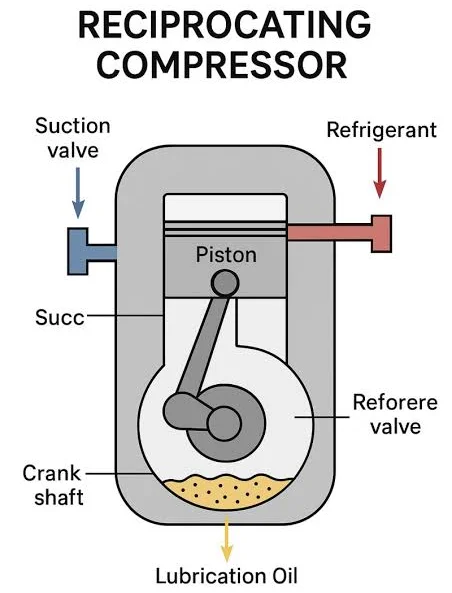
Reciprocating compressors operate via a crank-rod mechanism to drive pistons in linear reciprocating motion. The motor stator is bolted firmly to the pump body, while the internal movement assembly is supported by suspension or compression springs. Equipped with internal spring structures and muffler cavities, these compressors cushion vibration caused by fluctuating crankshaft torque and suppress noise transmission. However, they contain more than 80 components in general. Parts such as cylinders, pistons and connecting rods are complicated to machine; the pump body includes many castings, which consume large amounts of raw materials and lead to complicated assembly procedures. Reciprocating compressors cover a power range of 0.1HP to 3HP and dominate the household refrigeration market below 1HP. Restricted by their structural characteristics, they deliver limited displacement and are not ideal for high cooling capacity applications, mainly serving traditional household refrigeration equipment.
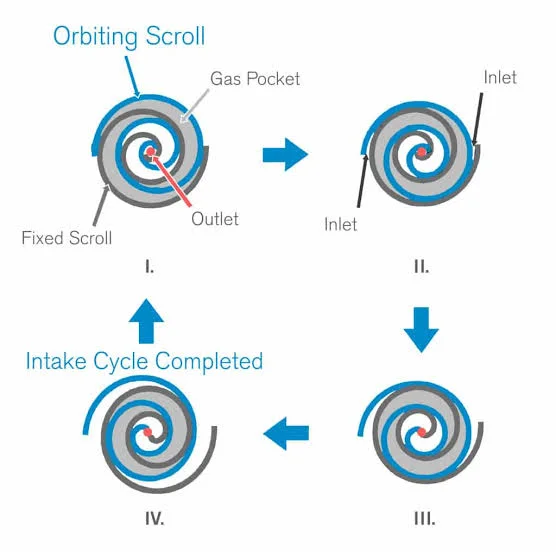
Scroll compressors work through the meshing of fixed and orbiting scroll wraps. The orbiting scroll performs orbital motion, forming multiple independent compression chambers. As the orbiting scroll revolves, the volume of compression chambers shrinks continuously to compress refrigerant, and there are no fragile reed valves. Their volumetric efficiency is 10% higher than that of rotary compressors. Simultaneous compression in multiple chambers creates uniform output torque, delivering well-balanced operation with low vibration, low noise and stable performance. Scroll compressors suit systems with fixed pressure ratios and relatively low operating pressure differentials, and are not applicable for severe working conditions requiring high pressure ratios or large pressure differences. They only require one-tenth of the parts used in reciprocating compressors and reduce overall volume by roughly 30%. Nevertheless, the scroll profile demands ultra-high machining precision. Its complex curved surfaces bring great difficulties to processing and inspection, resulting in high manufacturing costs. Scroll compressors are mainly available from 5HP to 15HP and widely used in air conditioning, heat pumps and commercial refrigeration.
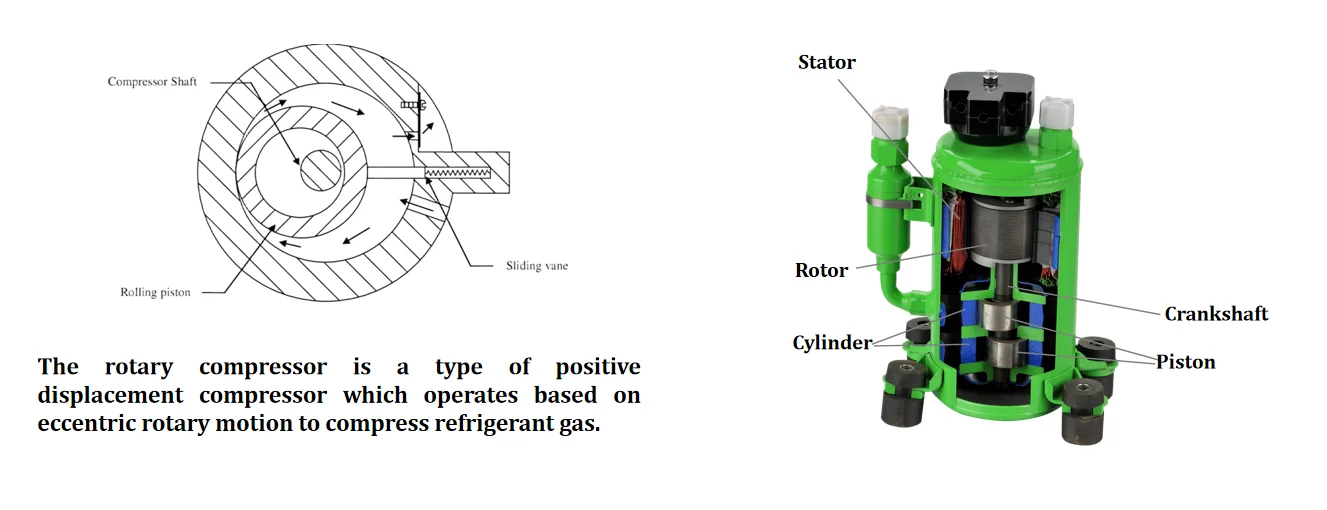
Rotary compressors adopt circular rotary motion. An eccentric pin drives a rolling rotor to rotate continuously inside the cylinder. The pump assembly and motor are fixed directly inside the shell, without suction valves or similar vulnerable parts, making the whole unit smaller and lighter. In terms of performance, rotary compressors achieve a COP 20%–30% higher than reciprocating models. They feature small clearance volume, no suction superheat and superior indicated efficiency, with an average performance coefficient around 20% higher than reciprocating compressors. They can run stably under LBP (low back pressure) and MBP (medium back pressure) conditions and show excellent off-design performance and reliability. From the manufacturing perspective, rotary compressors have one-third fewer components than reciprocating compressors. Most parts feature simple cylindrical, curved or flat surfaces for easy machining, giving them a notable cost advantage over scroll compressors. They also cover the power range of 0.1HP to 3HP. With continuous performance upgrades, their application scenarios keep expanding. They are gaining traction in emerging frozen and refrigeration markets and gradually replacing some reciprocating and scroll compressor models.
To sum up, the three types of compressors occupy distinct market positions. Reciprocating compressors are proven mature solutions for small-capacity household refrigeration with mature vibration and noise reduction designs, yet they are complicated to produce and hard to scale up for high cooling capacity. Scroll compressors are suitable for medium-to-large air conditioning and heat pump systems with quiet and stable running, but their high processing costs and working-condition limitations restrict wide adoption in high-pressure-ratio low-temperature freezing applications. Rotary compressors balance efficiency, reliability and manufacturing cost. Well adapted to medium and low-temperature frozen and refrigeration applications, they represent a highly competitive option for light commercial refrigeration.